Reign of Volagases I. His first attempt on Armenia fails. His quarrel with Izates. Invasion of Parthia Proper by the Dahce and Sacce. Second attack of Volagases on Armenia. Tiridates established as King. First expedition of Corbulo. Half submission of Volagases. Revolt of Vardanes. Second expedition of Corbulo. Armenia given to Tigranes. Revolt of Hyrcania. Third attack of Volagases on Armenia. Defeat of Paitus, and re-establishment of Tiridates. Last expedition of Corbulo, and arrangement of Terms of Peace. Tiridates at Rome. Probable time of the Death of Volagases.
Vonones the Second left behind him three sons, Volagases, Tiridates, and Paeorus. It is doubtful which of them was the eldest, but, on the whole, most probable that that position belonged to Paeorus. We are told that Volagases obtained the crown by his brothers yielding up their claim to him, from which we must draw the conclusion that both of them were his elders. These circumstances of his accession will account for much of his subsequent conduct. It happened that he was able at once to bestow a principality upon Paeorus, to whom he felt specially indebted; but in order adequately to reward his other benefactor, he found it necessary to conquer a province and then make its government over to him. Hence his frequent attacks upon Armenia, and his numerous wars with Rome for its possession, which led ultimately to an arrangement by which the quiet enjoyment of the Armenian throne was secured to Tiridates.
The circumstances under which Volagases made his first attack upon Armenia were the following. Pharasmanes of Iberia, whose brother, Mithridates, the Romans had (in A.D. 47) replaced upon the Armenian throne, had a son named Rhadamistus, whose lust of power was so great that to prevent his making an attempt on his own crown Pharasmanes found it necessary to divert his thoughts to another quarter.
Armenia, he suggested, lay near, and was a prize worth winning; Rhadamistus had only to ingratiate himself with the people, and then craftily remove his uncle, and he would probably step with ease into the vacant place. The son took the advice of his father, and in a little time succeeded in getting Mithridates into his power, when he ruthlessly put him to death, together with his wife and children. Rhadamistus then, supported by his father, obtained the object of his ambition, and became king. It was known, however, that a considerable number of the Armenians were adverse to a rule which had been brought about by treachery and murder; and it was suspected that, if an attack were made upon him, he would not be supported with much zeal by his subjects. This was the condition of things when Volagases ascended the Parthian throne, and found himself in want of a principality with which he might reward the services of Tiridates, his brother. It at once occurred to him that, a happy chance presented him with an excellent opportunity of acquiring Armenia, and he accordingly proceeded, in the very year of his accession, to make an expedition against it. At first he carried all before him. The Iberian supporters of Rhadamistus fled without risking a battle; his Armenian subjects resisted weakly; Artaxata and Tigranocerta opened their gates; and the country generally submitted. Tiridates enjoyed his kingdom for a few months; but a terrible pestilence, brought about by a severe winter and a want of proper provisions, decimated the Parthian force left in garrison; and Volagases found himself obliged, after a short occupation, to relinquish his conquest. Rhadamistus returned, and, although the Armenians opposed him in arms, contrived to re-establish himself. The Parthians did not renew their efforts, and for three years—from A.D. 51 to A.D. 54—Rhadamistus was left in quiet possession of the Armenian kingdom.'
It appears to have been in this interval that the arms of Volagases were directed against one of his great feudatories, Izatos. As in Europe during the prevalence of the feudal system, so under the Parthian government, it was always possible that the sovereign might be forced to contend with one of the princes who owed him fealty. Volagases seems to have thought that the position of the Adiabenian monarch was becoming too independent, and that it was necessary to recall him, by a sharp mandate, to his proper position of subordinate and tributary. Accordingly, he sent him a demand that he should surrender the special privileges which had been conferred upon him by Artabanus III., and resume the ordinary status of a Parthian feudatory. Izates, who feared that if he yielded he would find that this demand was only a prelude to others more intolerable, replied by a positive refusal, and immediately prepared to resist an invasion. He sent his wives and children to the strongest fortress within his dominions, collected all the grain that his subjects possessed into fortified places, and laid waste the whole of the open country, so that it should afford no sustenance to an invading army. He then took up a position on the lower Zab, or Caprius, and stood prepared to resist an attack upon his territory. Volagases advanced to the opposite bank of the river, and was preparing to invade Adiabene, when news reached him of an important attack upon his eastern provinces. A horde of barbarians, consisting of Dahse and other Scythians, had poured into Parthia Proper, knowing that he was engaged elsewhere, and threatened to carry fire and sword through the entire province. The Parthian monarch considered that it was his first duty to meet these aggressors; and leaving Izates unchastised, he marched away to the north-east to repel the external enemy.
Volagases, after defeating this foe, would no doubt have returned to Adiabene, and resumed the war with Izates, but in his absence that prince died. Monobazus, his brother, who inherited his crown, could have no claim to the privileges which had been conferred for personal services upon Izates; and consequently there was no necessity for the war to be renewed. The bones of Izates were conveyed to the holy soil of Palestine and buried in the vicinity of Jerusalem. Monobazus was accepted by Volagases as his brother's successor without any apparent reluctance, and proved a faithful tributary, on whom his suzerain could place complete dependence.
The quarrel with Izates, and the war with the Dahee and Sacse, may have occupied the years A.D. 52 and 53. At any rate it was not till A.D. 54, his fourth year, that Volagases resumed his designs against Armenia. Rhadamistus, though he had more than once had to fly the country, was found in possession as king, and for some time he opposed the progress of the Parthian arms; but, before the year was out, despairing of success, he again fled, and left Volagases to arrange the affairs of Armenia at his pleasure. Tiridates was at once established as king, and Armenia brought into the position of a regular Parthian dependency. The claims of Rome were ignored. Volagases was probably aware that the Imperial throne was occupied by a mere youth, not eighteen years old, one destitute of all warlike tastes, a lover of music and of the arts, who might be expected to submit to the loss of a remote province without much difficulty. He therefore acted as if Rome had no rights in this part of Asia, established his brother at Artaxata, and did not so much as send an embassy to Nero to excuse or explain his acts. These proceedings caused much uneasiness in Italy. If Nero himself cannot be regarded as likely to have felt very keenly the blow struck at the prestige of the Empire, yet there were those among his advisers who could well understand and appreciate the situation. The ministers of the young prince resolved that efforts on the largest scale should be made. Orders were at once issued for recruiting the Oriental legions, and moving them nearer to Armenia; preparations were set on foot for bridging the Euphrates; Antiochus of Commagene, and Herod Agrippa II., were required to collect troops and hold themselves in readiness to invade Parthia; the Roman provinces bordering upon Armenia were placed under new governors; above all, Corbulo, regarded as the best general of the time, was summoned from Germany, and assigned the provinces of Cappadocia and Galatia, together with the general superintendence of the war for retaining possession of Armenia. At the same time instructions were sent out to Ummidius, proconsul of Syria, requiring him to co-operate with Corbulo; and arrangements were made to obviate the clashing of authority which was to be feared between two equal commanders. In the spring of A.D. 55 the Roman armies were ready to take the field, and a struggle seemed impending which would recall the times of Antony and Phraates.
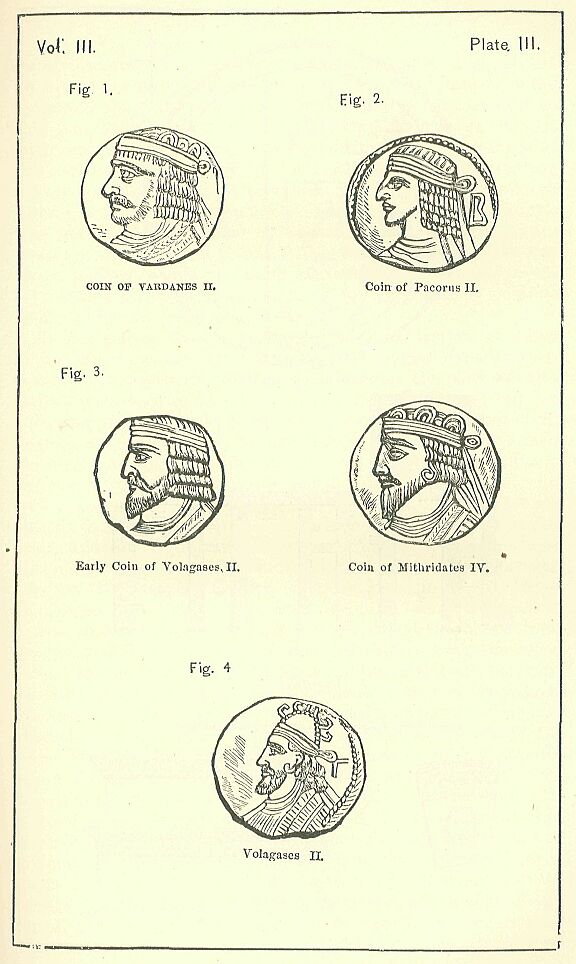
But, at the moment when expectation was at its height, and the clang of arms appeared about to resound throughout Western Asia, suddenly a disposition for peace manifested itself. Both Corbulo and Ummidius sent embassies to Volagases, exhorting him to make concessions, and apparently giving him to understand that something less was required of him than the restoration of Armenia to the Romans. Volagases listened favorably to the overtures, and agreed to put into the hands of the Roman commanders the most distinguished members of the royal family as hostages. At the same time he withdrew his troops from Armenia; which the Romans, however, did not occupy, and which continued, as it would seem, to be governed by Tiridates. The motive of the Parthian king in acting as he did is obvious. A revolt against his authority had broken out in Parthia, headed by his son, Vardanes; and, until this internal trouble should be suppressed, he could not engage with advantage in a foreign war. [PLATE III. Fig. 1.] The reasons which actuated the Roman generals are far more obscure. It is difficult to understand their omission to press upon Volagases in his difficulties, or their readiness to accept the persons of a few hostages, however high their rank, as an equivalent for the Roman claim to a province. Perhaps the jealousy which subsequently showed itself in regard to the custody of the hostages may have previously existed between the two commanders, and they may have each consented to a peace disadvantageous to Rome through fear of the other's obtaining the chief laurels if war were entered on.
The struggle for power between Volagases and his son Vardanes seems to have lasted for three years—from A.D. 55 to A.D. 58. Its details are unknown to us; but Volagases must have been successful; and we may assume that the pretender, of whom we hear no more, was put to death. No sooner was the contest terminated than Volagases, feeling that he was now free to act, took a high tone in his communications with Corbulo and Ummidius, and declared that not only must his brother, Tiridates, be left in the undisturbed possession of Armenia but it must be distinctly understood that he held it as a Parthian, and not as a Roman, feudatory. At the same time Tiridates began to exercise his authority over the Armenians with severity, and especially to persecute those whom he suspected of inclining towards the Romans. Oorbulo appears to have felt that it was necessary to atone for his three years of inaction by at length prosecuting the war in earnest. He tightened the discipline of the legions, while he recruited them to their full strength, made fresh friends among the hardy races of the neighborhood, renewed the Roman alliance with Pharasmanes of Iberia, urged Antiochus of Commagene to cross the Armenian frontier, and taking the field himself, carried fire and sword over a large portion of the Armenian territory. Volagases sent a contingent of troops to the assistance of his feudatory, but was unable to proceed to his relief in person, owing to the occurrence of a revolt in Hyrcania, which broke out, fortunately for the Romans, in the very year that the rebellion of Vardanes was suppressed. Under these circumstances it is not surprising that Tiridates had recourse to treachery, or that on his treachery failing he continually lost ground, and was at last compelled to evacuate the country and yield the possession of it to the Romans. It is more remarkable that he prolonged his resistance into the third year than that he was unable to continue the straggle to a later date. He lost his capital, Artaxata, in A.D. 58, and Tigranocerta, the second city of Armenia, in A.D. 60. After this he made one further effort from the side of Media, but the attempt was unavailing; and on suffering a fresh defeat he withdrew altogether from the struggle, whereupon Armenia reverted to the Romans. They entrusted the government to a certain Tigranes, a grandson of Archelaus, king of Cappadocia, but at the same time greatly diminished the extent of the kingdom by granting portions of it to neighboring princes. Pharasmanes of Iberia, Polemo of Pontus, Aristobulus of the Lesser Armenia, and Antiochus of Commagene, received an augmentation of their territories at the expense of the rebel state, which had shown itself incapable of appreciating the blessings of Roman rule and had manifested a decided preference for the Parthians.
But the fate of Armenia, and the position which she was to hold in respect of the two great rivals, Rome and Parthia, were not yet decided. Hitherto Volagases, engaged in a contest with the Hyrcanians and with other neighboring nations, whereto the flames of war had spread, had found himself unable to take any personal part in the struggle in which his brother and vassal had been engaged in the west. Now matters in Hyrcania admitted of arrangement, and he was at liberty to give his main attention to Armenian affairs. His presence in the West had become absolutely necessary. Not only was Armenia lost to him, but it had been made a centre from which his other provinces in this quarter might be attacked and harassed. Tigranes, proud of his newly-won crown, and anxious to show himself worthy of it, made constant incursions into Adiabene, ravaging and harrying the fertile country far and wide. Monobazus, unable to resist him in the field, was beginning to contemplate the transfer of his allegiance to Rome, as the only means of escaping from the evils of a perpetual border war. Tiridates, discontented with the position whereto he found himself reduced, and angry that his brother had not given him more effective support, was loud in his complaints, and openly taxed Volagases with an inertness that bordered on cowardice. Public opinion was inclined to accept and approve the charge; and in Parthia public opinion could not be safely contemned. Volagases found it necessary to win back his subjects' good-will by calling a council of the nobility, and making them a formal address: "Parthians," he said, "when I obtained the first place among you by my brothers ceding their claims, I endeavored to substitute for the old system of fraternal hatred and contention a new one of domestic affection and agreement; my brother Pacorus received Media from my hands at once; Tiridates, whom you see now before you, I inducted shortly afterwards into the sovereignty of Armenia, a dignity reckoned the third in the Parthian kingdom. Thus I put my family matters on a peaceful and satisfactory footing. But these arrangements are now disturbed by the Romans, who have never hitherto broken their treaties with us to their profit, and who will now find that they have done so to their ruin. I will not deny that hitherto I have preferred to maintain my right to the territories, which have come to me from my ancestors, by fair dealing rather than by shedding of blood—by negotiation rather than by arms; if, however, I have erred in this and have been weak to delay so long, I will now correct my fault by showing the more zeal. You at any rate have lost nothing by my abstinence; your strength is intact, your glory undiminished; you have added, moreover, to your reputation for valor the credit of moderation—a virtue which not even the highest among men can afford to despise, and which the Gods view with special favor." Having concluded his speech, he placed a diadem on the brow of Tiridates, proclaiming by this significant act his determination to restore him to the Armenian throne. At the same time he ordered Monseses, a Parthian general, and Monobazus, the Adiabenian monarch, to take the field and enter Armenia, while he himself with the main strength of the empire advanced towards the Euphrates and threatened Syria with invasion.
The results of the campaign which followed (A.D. 62) scarcely answered to this magnificent opening. Monseses indeed, in conjunction with Monobazus, invaded Armenia, and, advancing to Tigranocerta, besieged Tigranes in that city, which, upon the destruction of Artaxata by Corbulo, had become the seat of government. Volagases himself proceeded as far as Nisibis, whence he could threaten at the same time Armenia and Syria. The Parthian arms proved, however, powerless to effect any serious impression upon Tigranocerta; and Volagases, being met at Nisibis by envoys from Corbulo, who threatened an invasion of Parthia in retaliation of the Parthian attack upon Armenia, consented to an arrangement. A plague of locusts had spread itself over Upper Mesopotamia, and the consequent scarcity of forage completely paralyzed a force which consisted almost entirely of cavalry. Volagases was glad under the circumstances to delay the conflict which had seemed impending, and readily agreed that his troops should suspend the siege of Tigranocerta and withdraw from Armenia on condition that the Roman should at the same time evacuate the province. He would send, he said, ambassadors to Rome who should arrange with Nero the footing upon which Armenia was to be placed. Meanwhile, until the embassy returned, there should be peace—the Armenians should be left to themselves—neither Rome nor Parthia should maintain a soldier within the limits of the province, and any collision between the armies of the two countries should be avoided.
A pause, apparently of some months' duration, followed. Towards the close of autumn, however, a new general came upon the scene; and a new factor was introduced into the political and military combinations of the period. L. Caesennius Paetus, a favorite of the Roman Emperor, but a man of no capacity, was appointed by Nero to take the main direction of affairs in Armenia, while Corbulo confined himself to the care of Syria, his special province. Corbulo had requested a coadjutor, probably not so much from an opinion that the war would be better conducted by two commanders than by one, as from fear of provoking the jealousy of Nero, if he continued any longer to administer the whole of the East. On the arrival of Paetus, who brought one legion with him, an equitable division of the Roman forces was made between the generals. Each had three legions; and while Corbulo retained the Syrian auxiliaries, those of Pontus, Galatia, and Cappadocia were attached to the army of Paetus. But no friendly feeling united the leaders. Corbulo was jealous of the rival whom he knew to have been sent out as a check upon him rather than as a help; and Paetus was inclined to despise the slow and temporizing policy of the elder chief. The war, according to his views, required to be carried on with more dash and vigor than had hitherto appeared in its conduct—cities should be stormed, he said—the whole country plundered—severe examples made of the guilty. The object of the war also should be changed—instead of setting up shadowy kings, his own aim would be to reduce Armenia into the form of a province.
The truce established in the early summer, when Volagases sent his envoys to Nero, expired in the autumn, on their return without a definite reply; and the Roman commanders at once took the offensive and entered upon an autumn campaign, the second within the space of a year. Corbulo crossed the Euphrates in the face of a large Parthian army, which he forced to retire from the eastern bank of the river by means of military engines worked from ships anchored in mid-stream. He then advanced and occupied a strong position in the hills at a little distance from the river, where he caused his legions to construct an entrenched camp. Paetus, on his part, entered Armenia from Cappadocia with two legions, and, passing the Taurus range, ravaged a large extent of country; winter, however, approaching, and the enemy nowhere appearing in force, he led back his troops across the mountains, and, regarding the campaign as finished, wrote a despatch to Nero boasting of his successes, sent one of his three legions to winter in Pontus, and placed the other two in quarters between the Taurus and the Euphrates, at the same time granting furloughs to as many of the soldiers as chose to apply for them. A large number took advantage of his liberality, preferring no doubt the pleasures and amusements of the Syrian and Cappadocian cities to the hardships of a winter in the Armenian highlands. While matters were in this position Paetus suddenly heard that Volagases was advancing against him. As once before at an important crisis, so now with the prospect of Armenia as the prize of victory, the Parthians defied the severities of winter and commenced a campaign when their enemy regarded the season for war as over. In this crisis Paetus exhibited an entire unfitness for command. First, he resolved to remain on the defensive in his camp; then, affecting to despise the protection of ramparts and ditches, he gave the order to advance and meet the enemy; finally, after losing a few scouts whom he had sent forward, he hastily retreated and resumed his old position, but at the same time unwisely detached three thousand of his best foot to block the pass of Taurus, through which Volagases was advancing. After some hesitation he was induced to make Corbulo acquainted with his position; but the message which he sent merely stated that he was expecting to be attacked. Corbulo was in no hurry to proceed to his relief, preferring to appear upon the scene at the last moment, when he would be hailed as a savior.
Volagases, meanwhile, continued his march. The small force left by Paetus to block his progress was easily overpowered, and for the most part destroyed. The castle of Arsamosata, where Paetus had placed his wife and child, and the fortified camp of the legions, were besieged. The Romans were challenged to a battle, but dared not show themselves outside their entrenchments. Having no confidence in their leader, the legionaries despaired and began openly to talk of a surrender. As the danger drew nearer, fresh messengers had been despatched to Corbulo, and he had been implored to come at his best speed in order to save the poor remnant of a defeated army. That commander was on his march, by way of Commagene and Cappadocia; it could not be very long before he would arrive; and the supplies in the camp of Paetus were sufficient to have enabled him to hold out for weeks and months. But an unworthy terror had seized both Paetus and his soldiers. Instead of holding out to the last, the alarmed chief proposed negotiations, and the result was that he consented to capitulate. His troops were to be allowed to quit their entrenchments and withdraw from the country, but were to surrender their strongholds and their stores. Armenia was to be completely evacuated by the Romans; and a truce was to be observed and Armenia not again invaded, until a fresh embassy, which Volagases proposed to send to Rome, returned. Moreover, a bridge was to be made by the Romans over the Arsanias, a tributary of the Euphrates, which, as it was of no immediate service to the Parthians, could only be intended as a monument of the Roman defeat. Paetus assented to these terms, and they were carried out; not, however, without some further ignominy to the Romans. The Parthians entered the Roman entrenchments before the legionaries had left them, and laid their hands on anything which they recognized as Armenian spoil. They even seized the soldiers' clothes and arms, which were relinquished to them without a struggle, lest resistance should provoke an outbreak. Paetus, once more at liberty; proceeded with unseemly haste to the Euphrates, deserting his wounded and his stragglers, whom he left to the tender mercies of the Armenians. At the Euphrates he effected a junction with Corbulo, who was but three days' march distant when Paetus so gracefully capitulated.
The chiefs, when they met, exchanged no cordial greeting. Corbulo complained that he had been induced to make a useless journey, and to weary his troops to no purpose, since without any aid from him the legions might have escaped from their difficulties by simply waiting until the Parthians had exhausted their stores, when they must have retired. Paetus, anxious to obliterate the memory of his failure, proposed that the combined armies should at once enter Armenia and overrun it, since Volagases and his Parthians had withdrawn. Corbulo replied coldly—that "he had no such orders from the Emperor. He had quitted his province to rescue the threatened legions from their peril; now that the peril was past, he must return to Syria, since it was quite uncertain what the enemy might next attempt. It would be hard work for his infantry, tired with the long marches it had made, to keep pace with the Parthian cavalry, which was fresh and would pass rapidly through the plains." The generals upon this parted. Paetus wintered in Cappadocia; Corbulo returned into Syria, where a demand reached him from Volagases that he would evacuate Mesopotamia. He agreed to do so on the condition that Armenia should be evacuated by the Parthians. To this Volagases consented; since he had re-established Tiridates as king, and the Armenians might be trusted, if left to themselves, to prefer Parthian to Roman ascendancy.
There was now, again, a pause in the war for some months. The envoys sent by Volagases after the capitulation of Paetus reached Rome at the commencement of spring (A.D. 63), and were there at once admitted to an audience. They proposed peace on the terms that Tiridates should be recognized as king of Armenia, but that he should go either to Rome, or to the head-quarters of the Roman legions in the East, in order to receive investiture, either from the Emperor or his representative. It was with some difficulty that Nero was brought to believe in the success of Volagases, so entirely had he trusted the despatches of Paetus, which represented the Romans as triumphant. When the state of affairs was fully understood from the letters of Corbulo and the accounts given by a Roman officer who had accompanied the Parthian envoys, there was no doubt or hesitation as to the course which should be pursued. The Parthian proposals must be rejected. Rome must not make peace immediately upon a disaster, or until she had retrieved her reputation and shown her power by again taking the offensive. Paetus was at once recalled, and the whole direction of the war given to Corbulo, who was intrusted with a wide-spreading and extraordinary authority. The Parthian envoys were dismissed, but with gifts, which seemed to show that it was not so much their proposals as the circumstances under which they had been made that were unpalatable. Another legion was sent to the East; and the semi-independent princes and dynasts were exhorted to support Corbulo with zeal. That commander used his extraordinary powers to draw together, not so much a very large force, as one that could be thoroughly trusted; and, collecting his troops at Melitene (Malatiyeh), made his arrangements for a fresh invasion.
Penetrating into Armenia by the road formerly followed by Lucullus, Corbulo, with three legions, and probably the usual proportion of allies—an army of about 80,000 men—advanced against the combined Armenians and Parthians under Tiridates and Volagases, freely offering battle, and at the same time taking vengeance, as he proceeded, on the Armenian nobles who had been especially active in opposing Tigranes, the late Roman puppet-king. His march led him near the spot where the capitulation of Paetus had occurred in the preceding winter; and it was while he was in this neighborhood that envoys from the enemy met him with proposals for an accommodation. Corbulo, who had never shown himself anxious to push matters to an extremity, readily accepted the overtures. The site of the camp of Paetus was chosen for the place of meeting; and there, accompanied by twenty horsemen each, Tiridates and the Roman general held an interview. The terms proposed and agreed upon were the same that Nero had rejected; and thus the Parthians could not but be satisfied, since they obtained all for which they had asked. Corbulo, on the other hand, was content to have made the arrangement on Armenian soil, while he was at the head of an intact and unblemished army, and held possession of an Armenian district; so that the terms could not seem to have been extorted by fear, but rather to have been allowed as equitable. He also secured the immediate performance of a ceremony at which Tiridates divested himself of the regal ensigns and placed them at the foot of the statue of Nero; and he took security for the performance of the promise that Tiridates should go to Rome and receive his crown from the hands of Nero, by requiring and obtaining one of his daughters as a hostage. In return, he readily undertook that Tiridates should be treated with all proper honor during his stay at Rome, and on his journeys to and from Italy, assuring Volagases, who was anxious on these points, that Rome regarded only the substance, and made no account of the mere show and trappings of power.
The arrangement thus made was honestly executed. After a delay of about two years, for which it is difficult to account, Tiridates set out upon his journey. He was accompanied by his wife, by a number of noble youths, among whom were sons of Volagases and of Monobazus, and by an escort of three thousand Parthian cavalry. The long cavalcade passed, like a magnificent triumphal procession, through two thirds of the Empire, and was everywhere warmly welcomed and sumptuously entertained. Each city which lay upon its route was decorated to receive it; and the loud acclaims of the multitudes expressed their satisfaction at the novel spectacle. The riders made the whole journey, except the passage of the Hellespont, by land, proceeding through Thrace and Illyricum to the head of the Adriatic, and then descending the peninsula. Their entertainment was furnished at the expense of the state, and is said to have cost the treasury 800,000 sesterces (about L6250.) a day this outlay was continued for nine months, and must have amounted in the aggregate to above a million and a half of our money. The first interview of the Parthian prince with his nominal sovereign was at Naples, where Nero happened to be staying. According to the ordinary etiquette of the Roman court, Tiridates was requested to lay aside his sword before approaching the Emperor; but this he declined to do; and the difficulty seemed serious until a compromise was suggested, and he was allowed to approach wearing his weapon, after it had first been carefully fastened to the scabbard by nails. He then drew near, bent one knee to the ground, interlaced his hands, and made obeisance, at the same time saluting the Emperor as his "lord."
The ceremony of the investiture was performed afterwards at Rome. On the night preceding, the whole city was illuminated and decorated with garlands; the Forum, as morning approached, was filled with "the people," arranged in their several tribes, clothed in white robes and bearing boughs of laurel; the Praetorians, in their splendid arms, were drawn up in two lines from the further extremity of the Forum to the Rostra, to maintain the avenue of approach clear; all the roofs of the buildings on every side were thronged with crowds of spectators; at break of day Nero arrived in the attire appropriated to triumphs, accompanied by the members of the Senate and his body-guard, and took his seat on the Rostra in a curule chair. Tiridates and his suite were then introduced between the two long lines of soldiers; and the prince, advancing to the Rostra, made an oration, which (as reported by Dio) was of a sufficiently abject character. Nero responded proudly; and then the Armenian prince, ascending the Rostra by a way constructed for the purpose, and sitting at the feet of the Roman Emperor, received from his hand, after his speech had been interpreted to the assembled Romans, the coveted diadem, the symbol of Oriental sovereignty.
After a stay of some weeks, or possibly months, at Rome, during which he was entertained by Nero with extreme magnificence, Tiridates returned, across the Adriatic and through Greece and Asia Minor, to his own land. The circumstances of his journey and his reception involved a concession to Rome of all that could be desired in the way of formal and verbal acknowledgment. The substantial advantage, however, remained with the Parthians. The Romans, both in the East and at the capital, were flattered by a show of submission; but the Orientals must have concluded that the long struggle had terminated in an acknowledgment by Rome of Parthia as the stronger power. Ever since the time of Lucullus, Armenia had been the object of contention between the two states, both of which had sought, as occasion served, to place upon the throne its own nominees. Recently the rival powers had at one and the same time brought forward rival claimants; and the very tangible issue had been raised, Was Tigranes or Tiridates to be king? When the claims of Tigranes were finally, with the consent of Rome, set aside, and those of Tiridates allowed, the real point in dispute was yielded by the Romans. A Parthian, the actual brother of the reigning Parthian king, was permitted to rule the country which Rome had long deemed her own. It could not be doubted that he would rule it in accordance with Parthian interests. His Roman investiture was a form which he had been forced to go through; what effect could it have on him in the future, except to create a feeling of soreness? The arms of Volagases had been the real force which had placed him upon the throne; and to those arms he must have looked to support him in case of an emergency. Thus Armenia was in point of fact relinquished to Parthia at the very time when it was nominally replaced under the sovereignty of the Romans.
There is much doubt as to the time at which Volagases I. ceased to reign. The classical writers give no indication of the death of any Parthian king between the year A.D. 51, when they record the demise of Vonones II., and about the year A.D. 90, when they speak of a certain Pacorus as occupying the throne. Moreover, during this interval, whenever they have occasion to mention the reigning Parthian monarch, they always give him the name of Volagases. Hence it has been customary among writers on Parthian history to assign to Volagases I. the entire period between A.D. 51 and A.D. 90—a space of thirty-nine years. Recently, however, the study of the Parthian coins has shown absolutely that Pacorus began to reign at least as early as A.D. 78, while it has raised a suspicion that the space between A.D. 51 and A.D. 78 was shared between two kings, one of whom reigned from A.D. 51 to about A.D. 62, and the other from about A.D. 62 to A.D. 78. It has been proposed to call these kings respectively Volagases I. and Artabanus IV. or Volagases I. and Volagases II., and Parthian history has been written on this basis; but it is confessed that the entire absence of any intimation by the classical writers that there was any change of monarch in this space, or that the Volagases of whom they speak as a contemporary of Vespasian was any other than the adversary of Corbulo, is a very great difficulty in the way of this view being accepted; and it is suggested that the two kings which the coins indicate may have been contemporary monarchs reigning in different parts of Parthia. To such a theory there can be no objection. The Parthian coins distinctly show the existence under the later Arsacidae of numerous pretenders, or rivals to the true monarch, of whom we have no other trace. In the time of Volagases I. there was (we know) a revolt in Hyrcania, which was certainly not suppressed as late as A.D. 75. The king who has been called Artabanus IV. or Volagases II. may have maintained himself in this region, while Volagases I. continued to rule in the Western provinces and to be the only monarch known to the Romans and the Jews. If this be the true account of the matter, we may regard Volagases I. as having most probably reigned from A.D. 51 to about A.D. 78—a space of twenty-seven years.